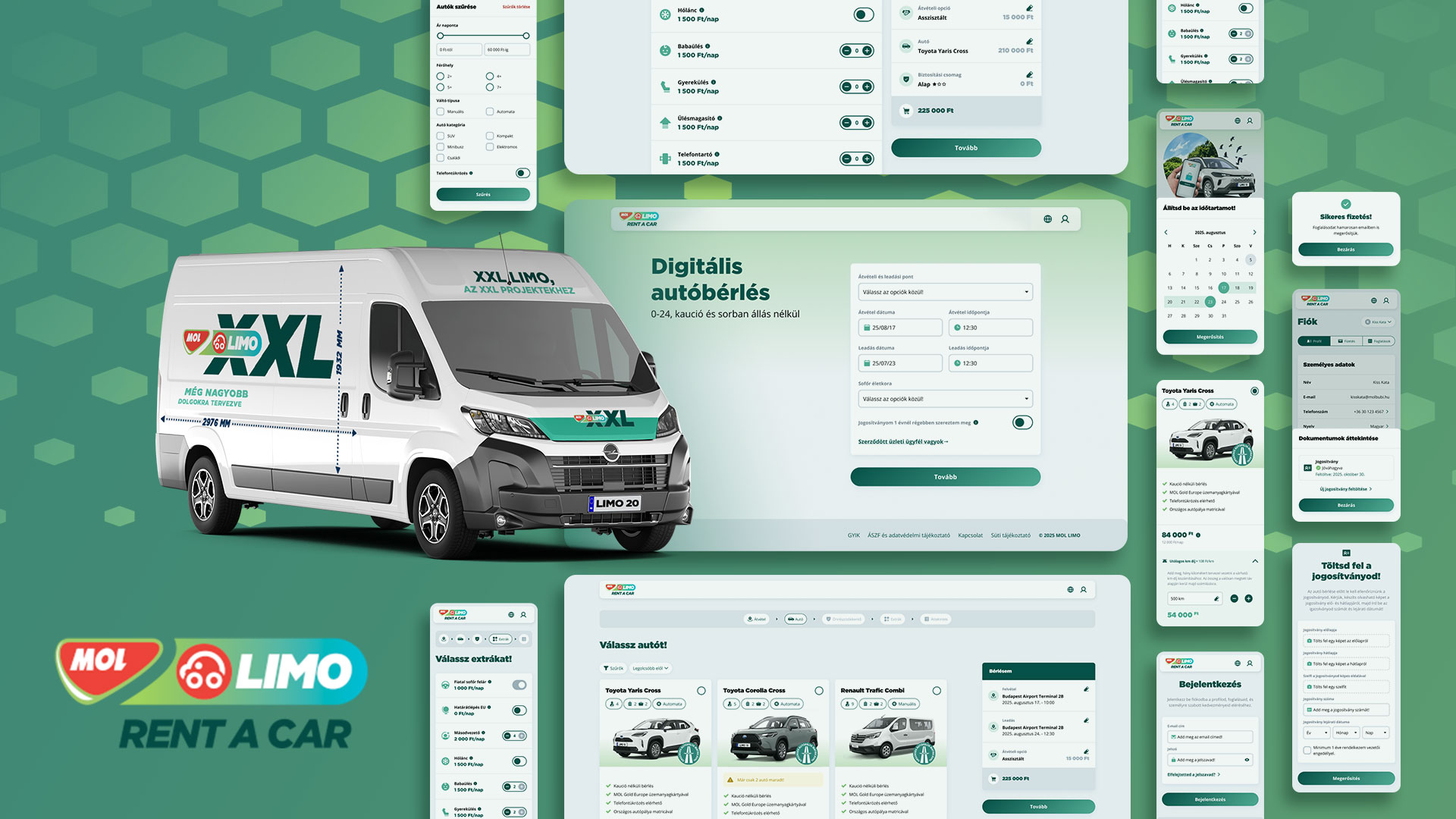
As MOL Limo expanded its rent-a-car functionality, webview-based interfaces were required to work reliably across multiple screen sizes and contexts. The core challenge was designing customer-facing and administrative interfaces that felt unified, clear, and scalable while fitting into an already defined product and brand ecosystem.
As UI designer, I worked closely with the product strategist and developers to turn predefined flows into high-fidelity designs. Using existing wireframes and the brand guide as constraints, I created a reusable component system in Figma and designed full screen sets for key journeys such as account creation and management, car rental, and information browsing. I also designed the administrative interface used to manage vehicles, stations, and reservations.
A key strategic decision was to prioritize modular components over screen-specific solutions. This allowed layouts to adapt smoothly to different screen sizes without duplicating design logic. I deliberately avoided visual over-customization and focused instead on clarity, hierarchy, and predictable interaction patterns to reduce friction in transactional flows.
The main challenge was designing webviews that felt native and consistent across devices while remaining technically realistic to implement. Close iteration with developers helped resolve edge cases around responsiveness, forms, and data-heavy screens.
The outcome was a cohesive, on-brand interface that served both customers and operations. Users could complete rental flows through embedded webviews, while internal teams gained clear, structured tools to manage the service. The component-based approach also laid the foundation for future feature expansion without requiring a full redesign.